
Medieval Walls In A Modern World
About the paper
- Publication date
- Reading time
Nov 27, 2026
8 min
Sources
Appiah, Kwame Anthony. The Lies That Bind : Rethinking Identity : Creed, Country, Colour, Class, Culture. London, Profile Books, 2019.
Yascha Mounk. The Identity Trap. Penguin Group, 23 Sept. 2025.
Varshney, Ashutosh. “India, Pakistan, and Kashmir: Antinomies of Nationalism.” Asian Survey,
vol. 31, no. 11, 1991, pp. 997–1019. JSTOR, https://doi.org/10.2307/2645304. Accessed
21 Apr. 2026.
“Massive DNA Sequencing Effort Reveals How Colonization Shaped Brazil’s Genetic Diversity.” AAAS Articles DO Group, 15 May 2025, www.science.org/content/article/massive-dna-sequencing-effort-reveals-how-colonization-shaped-brazil-s-genetic.
Wejsa, Shari, and Jeffrey Lesser. “Migration in Brazil: The Making of a Multicultural Society.” Migrationpolicy.org, Migration Policy Institute, 11 Apr. 2018, www.migrationpolicy.org/article/migration-brazil-making-multicultural-society.
Católico de IBGE – Wiktionary, the Free Dictionary.” Wiktionary, 2022, en.wiktionary.org/wiki/Cat%C3%B3lico_de_IBGE. Accessed 21 Apr. 2026.
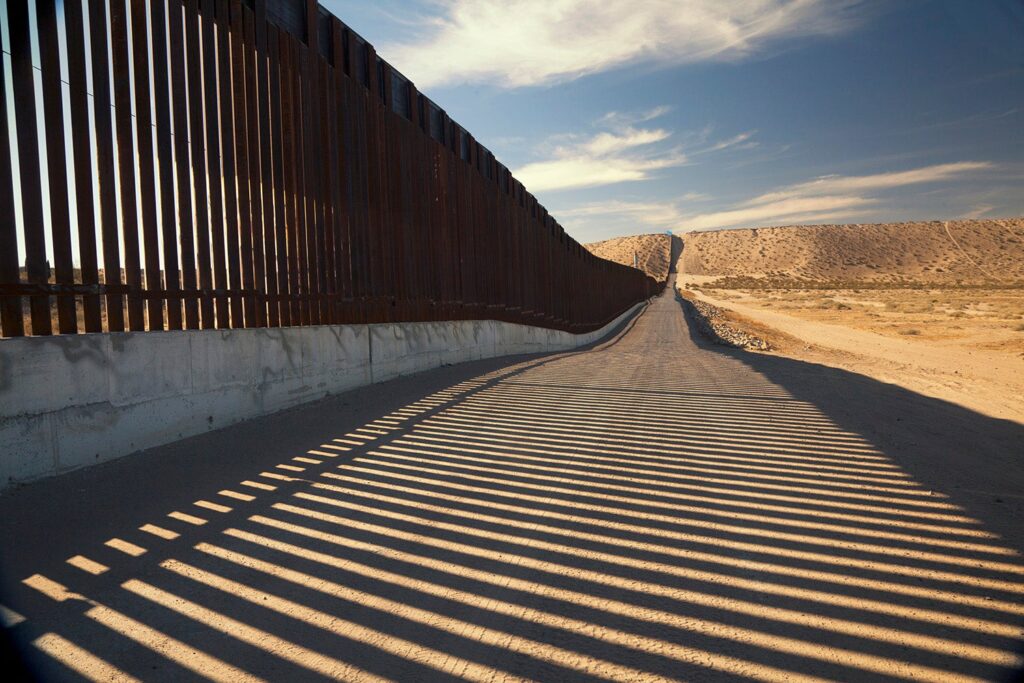
Throughout history, when groups have feared invasions, the solution was to build a large wall to protect the territory against external dangers. Although this idea seems to refer to the medieval age when lords built massive walls to guard their castles against invaders, it still happens today. This was the solution found by President Donald Trump in 2019 to “protect” the United States against immigrants (mainly Mexicans). In his statements about the wall construction, Trump himself refers to it as a “medieval solution,” but according to him, it is effective. This expression to name the wall carries the correct double meaning of how it can actually be an efficient security measure, but also illustrates how inadequate it is to deal with the complexity of modern migration. While Trump argues that the wall is necessary to address what he describes as a crisis at the southern border, critics charge that it ignores the structural factors that contribute to migration, such as violence and economic inequality, and instead risks increasing environmental damage and human rights abuses. In a rapidly changing world, then, the proposed “medieval” wall represents a conflict over how best to balance humanitarian responsibility with national security.
After analyzing the debate behind the construction of Trump’s wall, it is important to understand more deeply the meaning behind medieval walls. In the Middle Ages, borders functioned as both physical barriers and symbols for power and dominance over territory. Ross Samson argues in “Knowledge, Constraint, and Power in Inaction” that the purpose of these structures was to demonstrate the supremacy of those who built them, rather than to build barriers for protection. The author cites the example of Offa’s Dyke, an excavation built along the border between England and Wales during the Anglo-Saxon era. Although it was a physical protection, it served as a symbolic barrier that made anyone who crossed it acknowledge the power of King Offa and his powerful kingdom. The act of crossing the barrier served to emphasize its function as a representation of authority rather than a complete deterrent to invasion.
By recognizing the weight that a “medieval barrier” carries, it is possible to understand how this symbolic concept applies to Trump’s case. This logic can be seen in Trump’s border wall idea, which places more emphasis on the visual representation of power than on its actual effectiveness in solving migration. Similar to Offa’s Dyke, Trump is far more concerned with asserting authority than with organizing an effective project that is relevant to the modern world (since he ignores the causes of migration when he seeks to solve the problem). The wall has been called “medieval” by critics because it still uses the outdated logic of physical barriers in a society that needs more flexible solutions. Trump accepts the comparison and maintains his view that what worked in the past is still effective today. However, this argument ignores the reality that medieval walls often failed to achieve their goals and that their symbolism is what has kept them useful. Trump’s wall carries the potential to become a contemporary symbol of isolation rather than a useful tool for solving migration in the 21st century, just as Offa’s Dyke represented power but failed to stop people from continuing to cross the border.
In addition, even if Trump’s wall acts as a real barrier and will serve as a representation of power or division, it will not be the first throughout history. One famous example is the Great Wall of China, which, in addition to providing security, served to establish the emperor’s sovereignty over a vast territory. Another example is the Berlin Wall, which represented the ideological and physical separation between East and West. Similar to the walls of the Middle Ages, these barriers were powerful in imposing the limits of political or even cultural identity, although they were not entirely successful in blocking passage. They evolved from ‘simple structures’ to symbols of power. This historical tradition is one of the inspirations for Trump’s border wall. It represents control and division, much like Offa’s Dike or the Berlin Wall. However, history shows that walls cannot solve such complex problems as immigration. Instead of promoting understanding, they end up isolating groups. Trump’s proposed wall has the potential to become a symbol of exclusion, increasing the very divisions that immigration already creates, much like the Berlin Wall, which came to represent oppression.
When we look at the impact that other large walls have had on society, we realize that simply erecting a physical barrier to prevent a specific group of people from entering a territory is not the best solution. While they work symbolically, border walls rarely offer long-term solutions to migration problems. While increased border security may temporarily deter migration, such solutions also end up simply shifting migration flows in a more dangerous direction. As Victoria Rietig and Christian Bilfinger point out in their article entitled “A Wall Against Migration?” Increased border security in the United States throughout the 1990s resulted in more deaths in the desert, as migrants felt forced to take more dangerous routes. This would only lead to higher costs for border security measures such as police officers and monitoring; it may give the impression that illegal immigration is decreasing, but in fact it only puts people (who are already vulnerable) even more at risk. This contradiction shows how inadequate it is to address migration through physical barriers, a strategy that ignores broader factors such as economic inequality, violence, and climate change.
As a result of this inadequate solution to the complex immigration problem, a debate about human rights has arisen. In the discussion of border security, building a wall involves ensuring human rights that are often overlooked. In her book Human Rights on the Border, Ruth Gomberg-Muñoz emphasizes how crucial it is to put the safety and rights of all those affected by border policies first (especially migrants). Increasing border security, including building walls, can have negative effects, such as pushing migrants into higher-risk areas. Furthermore, border walls do not solve other problems, such as visa overstays, which are a major source of undocumented immigrants in the United States, although they can deter other types of migration. Gomberg-Muñoz argues that choosing to build physical barriers diverts attention from more humanitarian strategies that are needed, such as improving conditions in countries of origin or establishing safer legal migration routes. Therefore, creating a human rights-centered strategy would advocate for meaningful immigration reform that addresses the root causes of the problem, such as protecting individuals seeking asylum, while also considering the dignity, safety, and legal rights of migrants.
In summary, Trump’s planned border wall will be a limited solution that ignores the root causes of migration and will most likely fail to solve the problem. Addressing migration solely through barriers ignores the larger issues that drive individuals to leave their home countries, as demonstrated in Rietig and Bilfinger’s “Walls Against Migration?” Stronger border security coupled with inter-country discussions through international organizations to address the problem at its root would be a more efficient and compassionate strategy. The circumstances that force people to migrate can be improved in this way, for example by funding international development initiatives such as financial assistance to countries of origin. Furthermore, an emphasis on human rights is crucial, as Ruth Gomberg-Muñoz explains in “Human Rights on the Border.” Immigration reform could focus on establishing legal migration routes and ensuring that migrants’ rights are protected; for example, by increasing the number of temporary work visas, encouraging the creation of shelters, and fostering international collaboration to address migration comprehensively. Strategies like these would not only reduce the risks migrants face, but would also promote greater stability on a global scale, since immigration is not a problem unique to the country that suffers from receiving illegal immigrants. In this way, the United States, together with other countries, could develop a much more effective response to global migration than a wall would be.