
Books Analysis: The Lies That Bind
About the paper
- Publication date
- Reading time
Apr 20, 2026
8 min
Sources
Gomberg-Muñoz, Ruth. “Human Rights on the Border.” American Anthropologist, vol. 112, no. 1, 2010, pp. 143–44. JSTOR, http://www.jstor.org/stable/20638769. Accessed 7 Dec. 2024.
Rietig, Victoria, and Christian Bilfinger. “Walls Against Migration?: About Perceived Truth in the U.S. Migration Debate and the Effectiveness of Border Protection Measures.” Borders, edited by Gerhard Wahlers, Konrad Adenauer Stiftung, 2017, pp. 40–53. JSTOR, http://www.jstor.org/stable/resrep10101.6. Accessed 7 Dec. 2024.
Samson, Ross. “Knowledge, Constraint, and Power in Inaction: The Defenseless Medieval Wall.” Historical Archaeology, vol. 26, no. 3, 1992, pp. 26–44. JSTOR, http://www.jstor.org/stable/25616174. Accessed 7 Dec. 2024.
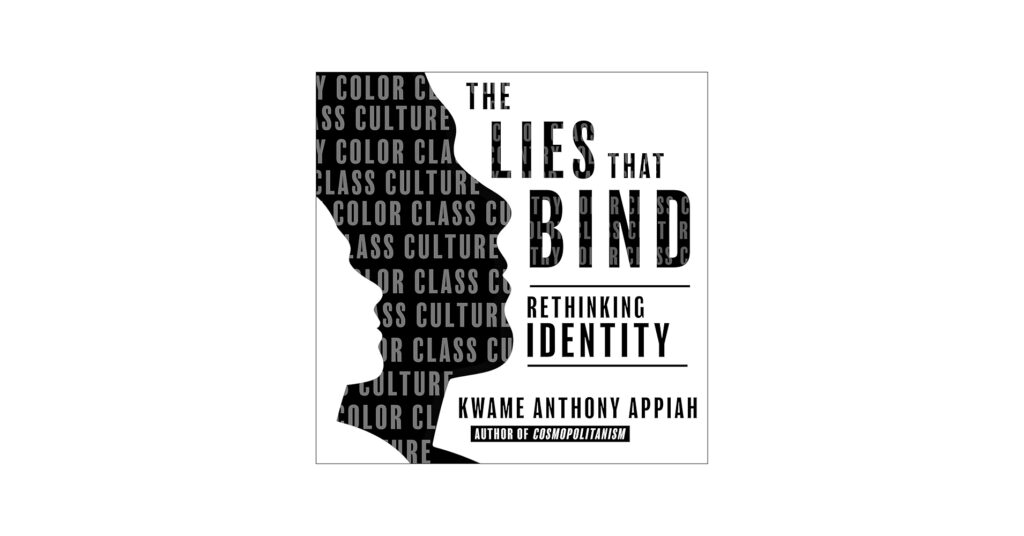
In his book The Lies That Bind, Kwame Anthony Appiah opens with an autobiographical scene to show that identity is not a simple thing, but a mixture of various factors like appearance, accent, family origin, nationality, and especially the social reading of others. The main point of the introduction is, first, to explain that identities are real because they shape how people live, perceive themselves, and how they are treated by those around them. Second, many of the ideas we use to think about identity are misleading, especially when we treat groups as if they had a common inner essence or when we treat identity as something inflexible. Rather than abolishing identity, Appiah wants to reform it and make our thinking about it less rigid and essentialist, as he criticizes. The author also explains that modern identity is not simply an intimate matter of self-knowledge; it is a social category shared by millions or billions of people. In the process of understanding what these “classifications” of identities have in common, his answer is that identities are classification systems that involve three things at the same time: a label, a set of expectations about who fits that label, and a form of social treatment tied to it. Labels are the entry point of identities, but they are never just names. These names carry criteria of application, disputes about who belongs to them or not, and expectations about how members should behave. This normative meaning described by the author means that when someone says “I am this,” they are not merely describing a fact, but taking on reasons to act in certain ways and feeling solidarity with other members of the group. Finally, identities also organize power; some are valued and others subordinated, so that belonging to a group can mean being treated with respect or with contempt. Overall, the framework Appiah proposes offers a clear and convincing way of understanding how identities function in social practice.
From a critical standpoint, I confess that my first reaction upon seeing the table of contents was surprised at not seeing “gender” as one of the classifications. Although Appiah makes clear that he used gender as the theoretical foundation of his analysis, and not as an object of study, this choice left me with a sense of absence. I believe the fact that an identity category has already been extensively studied, as he explains, does not justify its exclusion from a thorough comparative analysis; on the contrary, its theoretical maturity could enrich it. The five cases chosen by Appiah have a dedicated chapter, in which he traces their history, their misconceptions, and their political implications. Gender, by being treated only as a model, does not receive the same treatment, and I find that problematic, because it means its specificities as a lived identity become subordinate to its more methodological utility. Using gender as a lens is not the same as analyzing it; and a theory that sets out to reform thinking about identity should, precisely for that reason, apply its own critical framework to the category it chose as its foundation. On the other hand, one of the aspects I found most convincing in Appiah’s analysis is his incorporation of the concept of intersectionality, developed by legal theorist Kimberlé Crenshaw, already in the first chapter. Appiah uses it to show that multiple identities do not add up but intersect in ways that produce qualitatively distinct experiences; being a Black woman is not simply being a woman plus being Black, but it is occupying a social position that neither of those categories in isolation can describe. This recognition contrasts favorably with the treatment Yascha Mounk gives the concept in The Identity Trap, which he used to emphasize that empathy is possible regardless of lived experience (and regardless of the intersectionality a person carries). When we read the book I explained that Mounk ran the risk of minimizing precisely what Crenshaw and Appiah identify as central — that certain combinations of identity generate forms of exclusion irreducible to any of the separate categories. Appiah does not argue that understanding between groups is impossible, but unlike Mounk he does not ignore that the specificity of these crossed experiences demands to be taken seriously as an object of analysis, rather than bypassed by an appeal to universal empathy.
In the chapter “Creed,” Appiah deconstructs the prevailing modern view that religion is essentially a set of private beliefs or doctrines, demonstrating that it functions primarily as a social identity based on shared practices and community belonging. He argues that, contrary to what today’s emphasis on “correct belief” (orthodoxy) suggests, the core of religious traditions lies in “correct action” (orthopraxy), which includes rituals, moral obligations, forms of worship, and collective ways of life that define who belongs to the group, regardless of “perfect intellectual adherence.” “The trouble is that we’ve tended to emphasize the details of belief over the shared practices and the moral communities that buttress religious life” (Appiah 40). Appiah illustrates this by showing how sacred texts do not interpret themselves, but depend on community authorities and traditions. He emphasizes that religious identities are always contestable, since the boundaries of belonging are negotiated through disputes over who can claim the tradition, which practices are authentic, and how to reinterpret ancient scriptures. He also highlights that religions evolve historically, incorporating adaptations, which refutes any notion of a fixed or immutable essence. The author writes, “Once you think of creedal identities in terms of mutable practices and communities rather than sets of immutable beliefs, religion becomes more verb than noun: the identity is revealed as an activity, not a thing” (Appiah 67).
When it comes to Appiah’s argument that religious identities are contestable and depend on community practices rather than fixed doctrines, we can find a direct parallel in the conflicts studied in class, where religion functions less as genuine faith and more as a political tool. The concept of instrumentalism, discussed in class, defines identity as a strategic resource used by elites to consolidate power and mobilize populations. A case that explicitly demonstrates both ideas is the India-Pakistan dispute. As Ashutosh Varshney analyzes in an article about the Kashmir conflict, the 1947 partition was not motivated by a pure quarrel over theological differences (Hindus against Muslims), but by the political construction of two incompatible national identities. On one side, Indian secular nationalism, which claimed Kashmir to prove its capacity to integrate a majority-Muslim population into a secular state, and on the other, Pakistani religious nationalism, grounded in the two-nation theory, according to which Hindus and Muslims constituted essentially distinct and irreconcilable peoples. This conflict shows what Appiah also defends about how much religion and other identities define what is inside and what is outside, and how each identity deals with exterior groups according to what falls within its “duties” toward that identity. “Not only does your identity give you reasons to do things, it can give others reasons to do things to you” (Appiah 18). For example, Pakistani identity claims differentiation from Indian identity because of the “bonus” identities of being Muslim or Hindu; in this case, because of these identities, Pakistanis do not want to mix while Indians want the land to prove that being Indian is not just being Hindu. This also involves what Appiah would call orthopraxy (the practices and communities that actually define religious belonging), which in this case was subordinated to political narratives that essentialized religion as the reason why both countries should have control over Kashmir — exactly the mistake he criticizes in the chapter.
Despite the analytical richness of the chapter, Appiah defends the importance of recognizing that boundaries of belonging are contested, but this raised a question I did not feel was answered at any point in the book. When the boundaries of belonging, especially religious ones, are disputed, who has the authority to decide who belongs or not? Appiah acknowledges that religious identities are always contestable, as he himself describes: “all these dimensions of identity are contestable, always up for dispute: who’s in, what they’re like, how they should behave and be treated” (Appiah 20). But he treats this contestation more as a descriptive fact without offering even a criterion for resolving it. And this gap becomes evident in concrete cases. In Brazil we have a popular term “católico de IBGE,”(“Católico de IBGE – Wiktionary, the Free Dictionary”) or “catholic just for census,” to describe someone raised in a Catholic family but non-practicing, or in other words, someone who self-identifies as Catholic without fulfilling the orthopraxy obligations that Appiah places at the center of religious identity. But in practice, who decides whether this person fulfills Catholic practices: the person themselves, or their community? Appiah explains that upon entering the 20th century, the concept of identity stopped being oriented toward the self and became a classification tool. He concludes that “an identity cannot simply be imposed upon me, willy-nilly, but neither is an identity simply up to me, a contrivance that I can shape however I please” (Appiah 25). Catholicism, like other religions, has a volume of rules; and if this person goes to mass every Sunday but eats meat on Friday, are they Catholic or not? From another point of view, Muslims who condemn terrorist attacks frequently claim that perpetrators of violence in the name of Islam “are not real Muslims.” Still, who has the authority to identify a Muslim? Other Muslims or the person themselves? And these examples extend to other religions, showing a direct dispute over the limits of identity. Appiah even gives us tools to understand why this dispute exists, but he does not tell us how to resolve it or who has the legitimacy to do so. By treating contestation as an inevitable feature of identity without examining its implications for the authority of who can make these contests, I believe the chapter leaves open precisely the most difficult question when it comes to making any practical analysis about identity.
In the chapter “Country” (or “Nation”), Appiah questions what really constitutes a nation, challenging the more romantic and essentialist view that nations exist naturally through common ties (of ancestry, language, or shared culture), and proposing that they be understood as historical and political constructions. According to him, nations are invented, not discovered — using Italo Svevo’s idea, which he mentions: “inventing is a creation, not a lie” (Appiah 96) — to show that creating collective narratives that function as a unit is an act of building a political identity, or as he himself describes: “Scotland was not a fate but a project” (Appiah 97). The author also criticizes the nineteenth-century concept of Volksgeist (spirit of the people) for ignoring the inevitable internal diversity of any population, where regional differences have always coexisted. Appiah emphasizes that a nation is not defined solely by objective conditions (such as territory or common blood), but also by a subjective condition, in which people need to care about their shared history and desire to continue together — as Ernest Renan suggests in his concept of the “daily plebiscite,” in which the nation renews itself through the continuous desire for common life, not through fixed origins. He also warns of the Medusa Syndrome, when states attempt to fix national identities through official policies, petrifying something as dynamic as a society into a static and generally exclusionary form that crushes internal pluralities instead of creating solidarity (which he brings up at the beginning of the book as the best turn out of identity). In conclusion, Appiah argues that understanding nations as mutable projects allows for a more inclusive and especially flexible patriotism, preventing nationalism from becoming an ideological prison rather than a source of solidarity.
One of the arguments offered by Appiah in the chapter is that national disputes emerge precisely when symbolic and political boundaries do not coincide with the real experiences of populations, and when political leaders or states invoke “the people” to justify national decisions, they are assuming that a unified collective will exists — but in practice, within that same “people” there are groups with completely different identities that this language erases. As Appiah argues, “As a rule, people do not live in monocultural, monoreligious, monolingual nation-states, and they never have” (Appiah 84), and when this is ignored, national identity becomes an instrument of exclusion rather than solidarity. The case of Sri Lanka, studied in class, illustrates this precisely. After British independence in 1948, the majority Sinhalese state began implementing policies that broadly privileged Sinhalese culture, systematically marginalizing the Tamil minority, which possessed a distinct identity. What was officially “one people” concealed, in practice, two nations with radically different experiences of belonging. In this case, the Sinhalese state spoke in the name of “the people of Sri Lanka,” but was in practice speaking in the name of one specific nation (the Sinhalese one), ignoring that the Tamils were also part of that state but with a completely different experience of belonging. And this political exclusion of the Tamils ended up fueling decades of armed conflict. This confirms Appiah’s central argument that nations are not natural realities to be discovered, but political projects to be built; and when built in an exclusionary way, as in Sri Lanka, they become, in his words, a source of “war, horsemen of a score of apocalypses.” (Appiah 10).
As for the critique, or what was particularly missing in this chapter, it was a greater use of Latin American countries as objects of study. At the beginning of the book Appiah opens with the narrative of taxi drivers around the world trying to classify him by appearance and accent, and that scene reminded me directly of what it is like to be Brazilian in the United States. It is common to hear that I do not “look” Brazilian — since I am too white to be Brazilian, do not speak enough Spanish to be considered Latina, and not white enough to be American since I wasn’t even born here. And I believe these comments directly reflect what it means to be not only Brazilian, but Latin or even someone belonging to a nation while outside of it. These comments reveal something that Appiah identifies from the first chapter as one of the greatest dangers of identity: the stereotype. “Essentialism about identities is usually wrong: in general, there isn’t some inner essence that explains why people of a certain social identity are the way they are” (Appiah 34). Brazil is one of the most ethnically diverse countries in the world, formed historically by indigenous peoples, enslaved Africans, and immigrants from completely distinct origins. Genetics research confirms this — Brazil has the largest admixed population in the world and today is home to the largest Japanese population outside Japan, as well as significant European, Middle Eastern, and Latin American ‘nations’.(“Massive DNA Sequencing Effort Reveals How Colonization Shaped Brazil’s Genetic Diversity”; Wejsa and Lesser) And yet, when these people from “different nations” are taken outside of their context, they are reduced to a homogeneous image. When I started reading the “Country” chapter, I expected Appiah to develop further this phenomenon of what happens to national identity when it is judged outside its country of origin, by foreigners who apply stereotypes rather than understanding the real complexity. What becomes of the identity of a person from a given nation or country when they find themselves outside of it. That expectation was not met, because Latin America itself, rich in examples of diaspora and stereotyping, is completely absent from the chapter, with the exception of a single mention of Brazil regarding Lebanese immigration. This omission is significant because the region represents one of the most revealing cases of national identity precisely because it uniquely combines everything Appiah discusses (post-colonial nations, extreme racial diversity, and diasporas that carry their identity into contexts where it will inevitably be misread). By omitting Latin America, Appiah fails to analyze precisely the cases where his own theory would find its most revealing limits.